Key takeaways
- Battery Energy Storage Systems (BESS) help buildings manage peak demand, optimise energy costs and improve infrastructure capacity.
- Integrated into the electrical architecture, storage strengthens energy continuity and supports new uses such as ultra-fast EV charging.
- BESS provides flexibility to meet decarbonisation goals while adapting existing buildings to rising electrical constraints.
Energy storage: a new performance driver for buildings
For commercial and tertiary buildings, energy challenges are no longer limited to the reduction of consumption. Operators and designers must now deal with:
- growing power demand peaks,
- limited grid connection capacity,
- rising energy prices and contractual constraints,
- the integration of new electrical applications within existing infrastructure.
Energy storage addresses these challenges by providing flexibility at building level, particularly when integrated as part of a renewable energy battery storage strategy that is aligned with building decarbonisation objectives.
What does a BESS in commercial and tertiary buildings?
A Battery Energy Storage System (battery storage power station) deployed at building scale delivers concrete, measurable benefits when integrated into the electrical architecture, leveraging the robustness and reliability typically associated with industrial battery storage systems.
The following case study illustrates how this industrial-grade approach translates into tangible results in a real building environment.
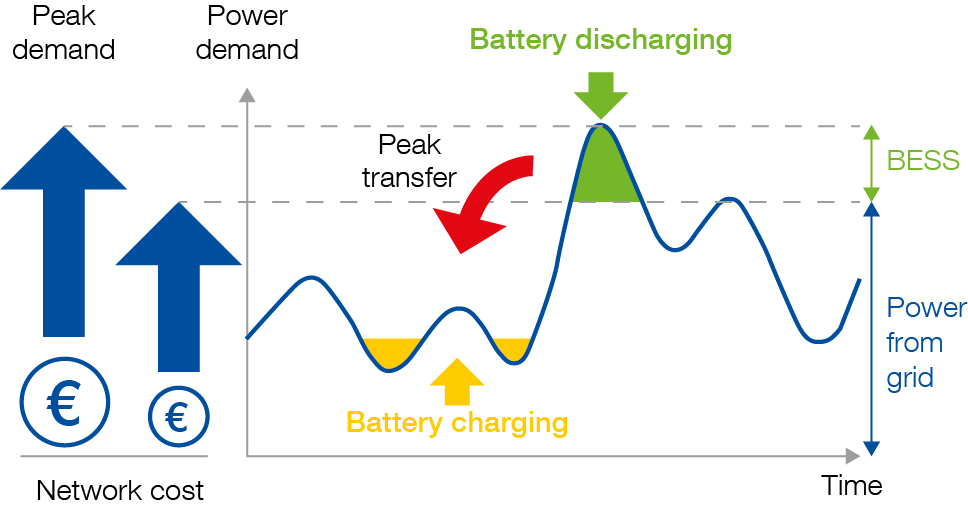
Power peaks remain one of the main cost drivers for buildings. A BESS helps to:
- limit peak demand drawn from the grid,
- reduce exceedance of subscribed power levels,
- stabilise energy costs over time.
By absorbing short-duration power spikes, storage contributes to a more predictable and controlled energy profile.
Night-time consumption is often underestimated, yet it can generate significant operational constraints. A BESS allows buildings to:
- store energy during off-peak periods,
- redistribute energy during high-demand phases,
- smooth the load curve over a 24-hour cycle.
This approach improves energy efficiency while reducing dependency on unfavourable tariff periods.
Beyond optimisation, energy storage plays a role in reinforcing operational continuity. When combined with existing electrical architectures, a BESS can support critical applications by:
- limiting exposure to grid disturbances,
- enhancing resilience during transient events,
- supporting existing continuity strategies.
Within buildings, energy storage never operates in isolation. Its value comes from having been integrated within a coherent electrical and energy management architecture.
A BESS interacts with:
- energy measurement and monitoring systems,
- protection and switching devices,
- energy management platforms coordinating loads and priorities.
This architectural approach transforms storage into an active component of building energy optimisation, rather than a standalone asset.
Example showing the addition of EV charging and battery energy storage to an existing installation
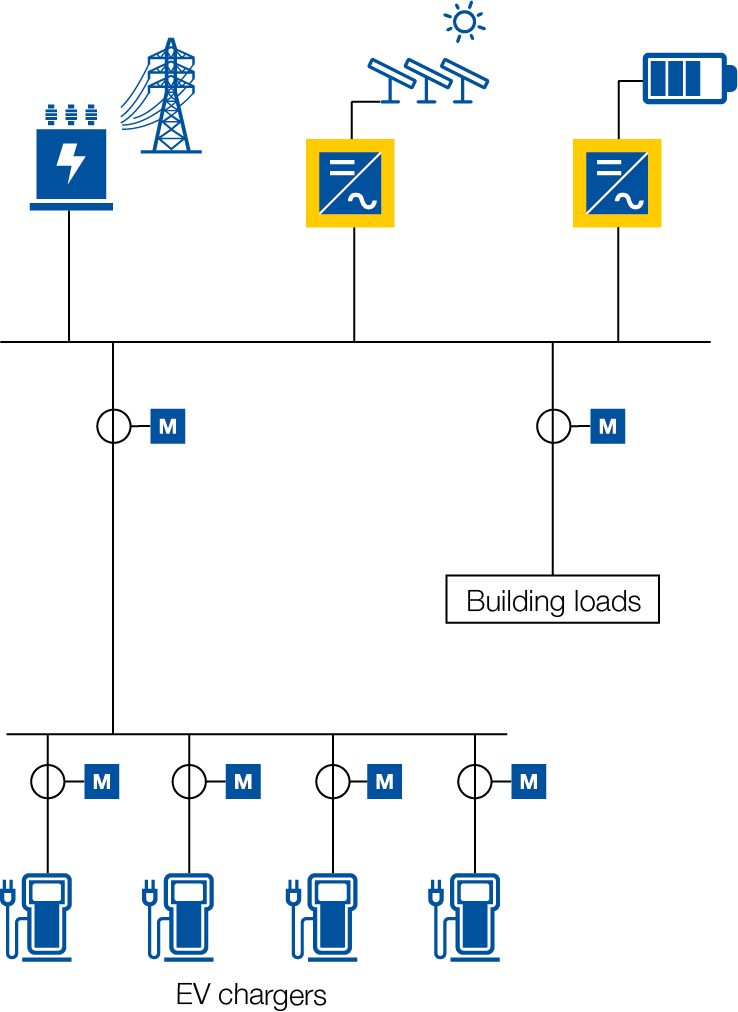
A shared objective across building projects is to achieve a sustainable, environmentally responsible image. Many commercial and tertiary buildings now integrate EV chargers alongside solar photovoltaic installations in order to demonstrate their commitment to reducing climate change.
This trend has been significantly accelerated by comprehensive UK and European regulations introduced in recent years, including the Energy Efficiency Directive (EED), Energy Performance of Buildings Directive (EPBD), Alternative Fuels Infrastructure Regulation (AFIR), and Corporate Sustainability Reporting Directive (CSRD), which provide both regulatory frameworks and financial incentives for green building technologies.
By including storage within the installation, it is possible to make an impact in a number of areas, in particular by reducing investments, reducing operating costs and generating additional revenue and income. These benefits are derived from the need and desire to reduce carbon emissions.
Supporting ultra-fast charging in commercial buildings
The deployment of ultra-fast charging infrastructure in commercial buildings introduces significant power constraints. In most cases, the challenge is not the charging equipment itself, but the available electrical capacity.
When integrated into a building’s energy architecture, a BESS can:
- absorb the high power peaks associated with fast charging sessions,
- limit the impact on other building loads,
- reduce the need for costly grid reinforcements.
For commercial buildings and tertiary parking facilities, energy storage enables charging infrastructure to scale without compromising overall building performance.
To explore this topic further, discover how energy storage enables the deployment of EV charging infrastructure while preserving building performance.

Adapting energy storage to different building profiles
Energy storage strategies must be aligned with the specific operational profile of each building type.
Office buildings
- Concentrated power peaks during working hours
- Progressive integration of new electrical applications
- The need for predictable energy costs
A BESS supports load smoothing and infrastructure scalability.
Commercial buildings
- Simultaneous loads with high variability
- Significant constraints on operational continuity
- Growing integration of charging infrastructure
Energy storage projects require building expertise
Deploying Battery Energy Storage Systems across multiple BESS sites within building portfolios requires more than the selection of storage capacity. Energy storage delivers its full value only when designed as part of a building-centric energy strategy.
Discuss your building energy storage project with a Socomec expert and explore how BESS can support your energy performance and infrastructure strategy.
FAQ : BESS definition, BESS technical specifications and functionality
What is a BESS and what does BESS mean?
BESS stands for Battery Energy Storage System. It refers to a system that stores electrical energy in batteries and makes it available when needed. In a commercial and industrial building context, a BESS is used to improve energy flexibility, manage power constraints and optimise how electricity is consumed, stored and redistributed on site. A BESS is an energy storage solution comprising batteries, power conversion equipment and control systems. Installed at building scale, it is integrated into the electrical architecture to support energy optimisation, continuity of supply and infrastructure performance, rather than acting as a standalone asset.
What is the purpose of a BESS in a building?
The main purpose of a BESS in a commercial or tertiary building is to increase energy flexibility and enable greater energy autonomy. It helps reduce peak demand, optimise energy use over time, support critical loads and accommodate new electrical applications such as fast EV charging, without overloading the existing grid connection.
How does a BESS work?
A BESS stores electrical energy when demand is low or when conditions are favourable, and releases it when demand increases or constraints arise. In buildings, its operation is coordinated with energy management systems to ensure that stored energy is used at the right time and for the right purpose, in line with operational priorities.
Is a BESS suitable for existing buildings?
Yes. A BESS can be integrated into both new and existing buildings, provided it is designed according to the building’s electrical architecture, usage profile and operational constraints. When properly engineered, energy storage allows existing infrastructures to adapt to evolving energy needs without major structural changes.
What is a BESS in construction?
In construction, a BESS (Battery Energy Storage System) refers to an energy storage solution that is designed, specified and integrated as part of a building’s electrical and energy architecture. For new building projects, a BESS is considered during the design or refurbishment phase to manage power demand, optimise energy performance, support future applications and ensure that the electrical infrastructure is scalable, resilient and compliant with operational requirements.