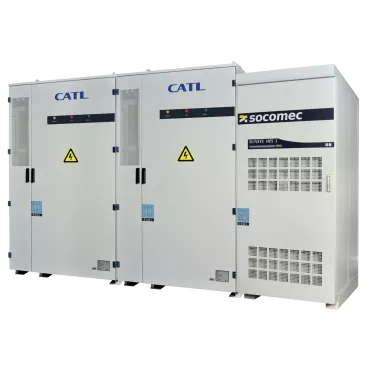
Project at a glance
At its Innovation Center in Benfeld (France), Socomec needed to install multiple EV charging stations for employees, visitors and fleet vehicles – without reinforcing the grid connection and without increasing energy costs in a context of unstable electricity prices.
By combining rooftop PV, a SUNSYS HES L Battery Energy Storage System and smart monitoring with SoLive PRO, the Innovation Center now operates as a prosumer building. It delivers more EV charging power on a limited 100 kW grid, maximises self-consumption of solar energy and reduces dependence on the grid – all while supporting Socomec’s CO₂ reduction target.
“I needed to install charging stations without increasing the electrical power of my site. My ambition was clear: to prioritise the use of energy that I produce locally in order to reduce my costs and improve the site’s carbon footprint.”
Aurélien Lauwerier
Facility Manager, Socomec
Key figures and outcomes
- Integrate EV charging without grid reinforcement
- Reduce exposure to energy price volatility
- Prepare the building for flexibility services and regulatory compliance
- Contribute to Socomec’s trajectory to cut CO₂ emissions by 58% by 2030
EV charging growth on a limited grid
The Socomec Innovation Center is a flagship building within the Benfeld headquarters. It brings together innovation teams in a living lab where new energy and digital solutions are created and tested at full scale.
To support new mobility behaviours and comply with regulations on EV-ready non-residential car parks, Socomec deployed a significant EV charging infrastructure on this site. This new load was added on a limited 100 kW grid connection dedicated to charging.
Very quickly, the Facility Manager faced a core challenge:
- How to absorb high, concentrated charging peaks, especially in the morning,
- Without reinforcing the electrical infrastructure or increasing contracted power,
- And while protecting the site from rising and unstable electricity prices.
At the same time, European and national regulations (EED, EPBD, AFIR, LOM, etc.) were pushing buildings to integrate more renewables, improve energy efficiency and prepare for flexibility services. The Innovation Center had to be both a compliant building and a showcase for Socomec’s prosumer capabilities.
The solution
A prosumer architecture with PV, BESS and smart control
Self-production and self-consumption with solar and BESS
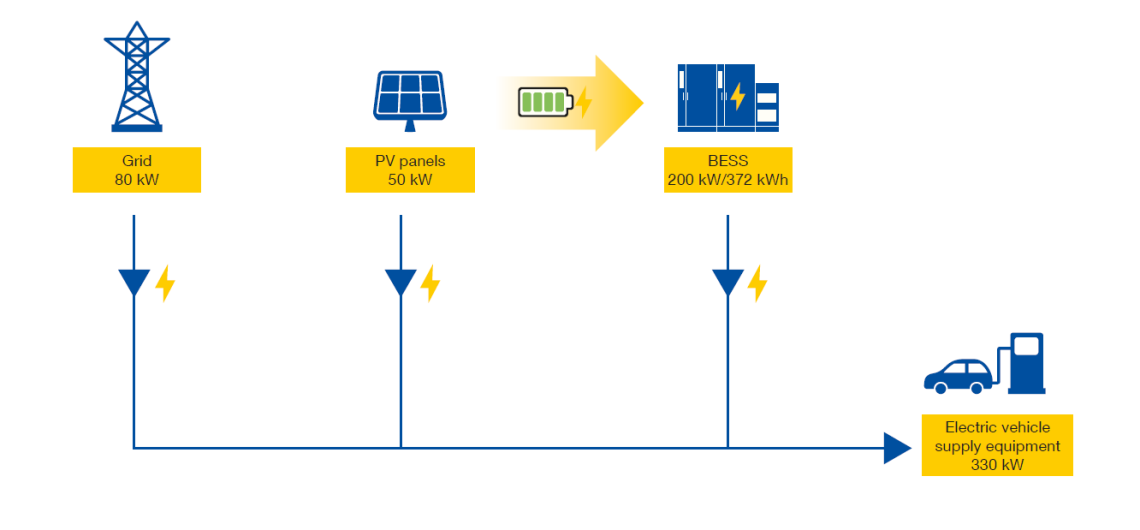
Socomec designed an independent energy hub built around the SUNSYS HES L BESS, balancing production, storage and consumption:
- Self-production – Rooftop PV panels generate renewable energy primarily dedicated to EV charging.
- Self-consumption – When PV production exceeds the building’s needs, the energy surplus is stored in the BESS or used by the building instead of being curtailed or exported immediately.
- Smart discharge – The BESS releases stored energy when demand exceeds the available 100 kW from the grid and when grid electricity is more expensive (peak hours), ensuring charging performance while reducing electricity bills.
As a result, the Innovation Center now operates as a prosumer building: it uses energy storage to decouple EV charging needs from grid constraints and to optimise the use of local renewables.
“Today, I have an efficient and completely autonomous system. I don’t have to manage anything: thanks to the automatic control system, the energy is distributed smartly according to the number of connected vehicles and availability.”
Smart seasonal programming
100% self-consumption in summer, optimised grid use in winter
The system is programmed to adapt to seasonal conditions:
- In summer – PV production is high, and the prosumer system runs in full self-consumption mode. PV generation and the SUNSYS HES L BESS together cover EV charging loads, so the installation does not rely on electricity from the grid during this period.
- In winter – When solar production is low, the SUNSYS HES L charges from the grid during off-peak hours and discharges during peak and peak-shaving periods.
For facility managers, this means the building can still reduce its energy bill even when PV panels produce little or no energy. A significant share of consumption is shifted to cheaper off-peak periods, while the battery supplies EV charging during the most expensive hours. This seasonal strategy keeps the prosumer building cost-efficient all year round.
Smart building monitoring
SoLive PRO and DIRIS Digiware
To operate the Innovation Center as a real smart building, Socomec set up a complete electrical and control infrastructure that connects all prosumer assets - PV, BESS, EV chargers and grid connection - to a single cloud-base monitoring platform: SoLive PRO.
SoLive PRO collects real-time data from the SUNSYS HES L system and from the site’s metering devices, then processes and visualises this information in the cloud through predefined and customised dashboards. Operators can access a consolidated view of PV production, battery analytics, EV charging power and grid import/export, as well as key alarms and operating conditions. This provides an instant, intuitive picture of possible improvement paths to support corrective decision-making.
Behind the scenes, DIRIS Digiware provides the high-accuracy measurement points across AC and DC circuits (PV, BESS, EV chargers, building loads and grid incomer). This ensures granular, reliable data for SoLive PRO and supports proper cost allocation.
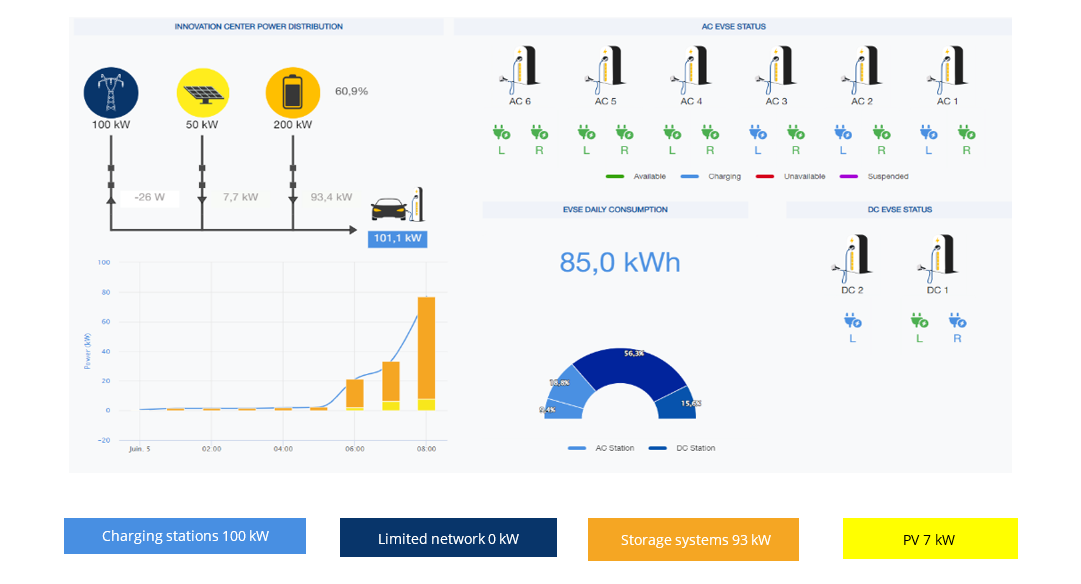
This application, the combination of DIRIS Digiware in the field and SoLive PRO in the cloud turns the Innovation Center into a fully instrumented, smart building: monitored in real time, EED and EBPD compliant, and continuously optimised for energy efficiency, savings and performance.
Results and ROI
More charging, less dependency on the grid
The prosumer solution delivers clear, measurable benefits:
These results show how a commercial building can support EV charging growth, remain within grid constraints and protect operating budgets – while actively contributing to decarbonisation targets.
“I don’t have to manage anything. Everything happens in the background and I don’t have to worry about the power that my site needs.”