Key Takeaways
Buildings are a major source of energy consumption and cost in Europe, representing around 40% of final energy use. As demand grows more complex with EV charging, advanced HVAC systems, and digital infrastructure, managing energy distribution and controlling operational costs is becoming increasingly challenging. Accurate energy metering is now essential to ensure supply reliability and optimize energy performance.
- Emerging loads are increasing pressure on electrical capacity and energy costs
- Energy metering is critical for cost control, supply security, and performance proof
- Socomec delivers end-to-end energy measurement: meters, sensors, gateways, and software
- Data-driven insights enable smarter management at building and portfolio level
Buildings: creating clarity from energy blind spots
Buildings represent one of the largest and least controlled cost items in Europe. According to the European Commission, they account for around 40% of final energy use.
At the same time, the distribution of energy consumption in a building is becoming harder to manage. EV charging, high-efficiency HVAC systems, digital infrastructure and process loads are reshaping demand profiles and putting pressure on electrical capacity, energy supply and costs.
To stay in control, energy consumption metering in buildings is no longer optional - it is critical. Not only to measure energy, but to secure supply, control costs and prove performance.
Socomec supports building owners and operators across the complete energy measurement chain – from meters and current sensors to data acquisition, communication gateways and software – so you can move from energy opacity to fact-based decisions at building and portfolio level.
For those who guarantee energy supply and performance with measured energy
Energy measurement is now a strategic lever for organisations that must balance cost control, regulatory compliance and operational continuity.
For those responsible for managing facilities and energy, ESCOs and building owners, structured energy metering provides the visibility needed to control costs and manage the energy mix, secure supply, meet regulations and integrate new loads without disrupting operations.
Facility Managers and Energy Managers
Your challenges:
- Guarantee availability while cutting consumption and emissions
- Validate your energy strategy with reliable, traceable data
- Aggregate data automatically across multi-site portfolios
- Comply with EU regulations, IT and cybersecurity requirements
How measurement helps:
Energy consumption metering replaces a single utility bill with a clear view of the distribution of energy consumption within a building - including air conditioning, lighting, IT, EV charging and key loads.
Multi-circuit architectures (e.g. DIRIS Digiware) enable fast deployment on electrical boards and seamless integration into your BMS panel or EMS, without disrupting operations.
ESCOs
Your challenges:
- Proving and sustaining energy savings
- Ensuring project bankability and cash-flow stability
- Managing data complexity under growing regulatory pressure
How measurement helps:
For ESCOs, energy measurement solutions for buildings turn performance commitments into verifiable results.
Multi-point meters, MID-compliant sub-billing meters and energy management software establish robust baselines and savings curves that can be audited at any time.
Measurement as an enabler of compliance and performance
Measured energy is what turns regulatory compliance into operational performance. Accurate energy consumption metering within a building simplifies audits, strengthens baseline tracking and feeds directly into EPBD, EED, CSRD and ESG reporting.
The same dataset used for daily operations becomes evidence of compliance, reducing duplication and administrative effort.
ISO 50001: prove energy performance, not intentions
ISO 50001 relies on structured energy measurement and monitoring to turn objectives into measurable results.
“Each of these texts refers to the implementation of an energy measurement and monitoring plan, which is one of the essential tools today. With the increase in energy prices, the underlying trend is towards reducing consumption. Especially since energy remains a significant expense for businesses, there is also a certain economic obligation to control these costs.”
Olivier GOUJON, Area Business Developer – Energy Efficiency Solutions, Socomec
From data to action: unlock your buildings’ energy potential
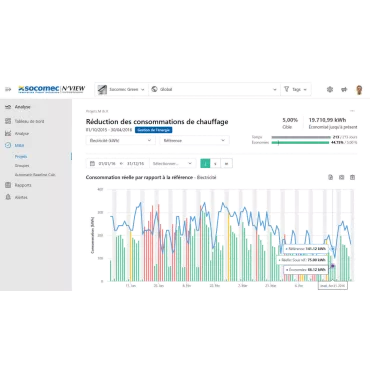
Accurate data is the foundation of any modern energy strategy, especially in terms of optimisation, compliance and investment decisions. This requires more than standalone meters – it demands a coherent energy measurement system connecting field devices, EMS and BMS software.
Reveal energy-use patterns
An accurate multi-point monitoring system combined with current sensors provides granular visibility by zone, usage and major load: air conditioning, lighting, process, IT and EV charging.
Complex electrical installations become a readable energy map, making demand fluctuations easy to analyse over time.
Detecting demand spikes and baseline consumption
Detailed consumption data makes it possible to identify peak loads - for example when HVAC, lifts and office equipment start simultaneously in the mornings.
Knowing when peaks occur is essential, as they often drive energy costs and contractual penalties.
Recognising night-time baseline usage
Night-time baseload highlights equipment that remains permanently energised (IT, security, refrigeration), often revealing hidden inefficiencies. As an example, emergency lighting, servers, refrigeration units, or security systems typically contribute to overnight baseload.
This level is normally much lower than peak demand and highlights the systems and equipment that remain powered continuously.
Centralising energy data provides a structured view across buildings, systems and time periods. By comparing profiles, organisations can quickly identify:
- HVAC running outside occupancy hours
- lighting in low-use areas
- abnormal increases in baseload
When interoperable with BMS and control systems, energy data enables advanced optimisation strategies and informed operational decisions.




Energy management and efficiency for buildings - FAQ
How are energy measurement solutions relevant to commercial buildings?
They provide granular data on HVAC, lighting, IT rooms and tenants, support cost allocation, reveal inefficient zones and help integrate EV charging without destabilising the building’s load profile.
What is building energy measurement and how is it different from simple metering?
Metering counts kWh for billing. Building energy measurement goes further: it combines meters, sensors, communication and software to show where and how energy is used, with dashboards, KPIs and reports to support decisions.
How does a building energy measurement solution help Facility Managers and Energy Managers?
It replaces a single utility bill with a detailed breakdown of HVAC, lighting, IT, EV charging, process loads and common services, so Facility and Energy Managers can benchmark sites, detect drifts early and target actions with real impact.
Why is a metering system a strategic asset for ESCOs?
For ESCOs, metering underpins performance contracts. It provides reliable baselines, IPMVP-compliant measurement and verification and auditable savings data, reducing disputes and proving that guaranteed ROI and energy savings are delivered.
How do owners of Commercial and Industrial (C&I) buildings benefit from energy measurement solutions?
C&I owners use energy measurement to control operating costs, decarbonise assets and report to investors and tenants. Granular metering identifies the most energy-intensive items, and supports renovation plans, financing and fair cost allocation.
How can retail buildings benefit from energy metering and monitoring systems?
In logistics and retail buildings, metering stabilises peak loads, prevents equipment stress of HVAC, and improves cold chain and lighting efficiency. MID-compliant meters also secure precise sub-billing and verify tenant bills and product conditions.
Why is multi-site energy monitoring a challenge for Facility Managers?
Because sites mix grid, PV, BESS, EV charging and industrial loads, often on high-power DC, with fragmented data and safety constraints. Facility Managers need consistent, actionable information across all locations, not isolated kWh readings.
How does energy consumption metering support current and future regulatory requirements?
A robust metering system delivers traceable, time-stamped data for EPBD, EED, national schemes, ISO 50001 and ESG. The same measurements used to run the building feed audits, baselines, labels and reports, simplifying compliance over time.
Building management system and metering system: are they complementary?
Yes. The BMS controls and automates HVAC, lighting and systems, while the metering system measures and analyses energy use. Together they let you both act and prove: you optimise operation based on accurate data and verify performance.
What is a building management system?
A building management system (BMS) is a central platform that monitors and controls a building’s HVAC, lighting and other technical systems, automating operation to maintain comfort, optimise energy use and reduce operating costs.
What does BMS stand for?
BMS stands for building management system, also called building automation system (BAS) or building energy management system (BEMS) when it focuses more specifically on monitoring and optimising energy use.