The customer: Six Degrees
Leading technology service provider, Six Degrees, provides integrated managed data services linking people, places and clouds. Trusted with high profile mission critical technology around the world, Six Degrees deploys platforms of innovation to host applications and websites.
Leveraging the group’s technical expertise, Six Degrees creates successful business outcomes for its partners by bringing technology alive through its people. Defining IT and infrastructure requirements, Six Degrees helps its customers to create better businesses and organisations across the public and private sectors.
Whether keeping patient records safe, retailers trading or providing disaster recovery services, Six Degrees 1000 data centre racks deliver critical support across multiple sectors. With 4 million voice minutes billed per day, Six Degrees enables charities to raise money, helps banks to trade and enables professional services to bill.
Goals and needs
With a reputation built on robustness and reliability, Six Degrees needed a critical power infrastructure to exceed its customers’ expectations. Trading in living technology, around the clock support is vital to the Six Degrees and its partners.
By integrating smart technology within the data centre’s infrastructure, Six Degrees can develop an unparalleled understanding of sites, buildings and processes. This new connectivity - combined with a universal view of operating parameters – will enable a reduction in energy consumption, costs and emissions and make the deployment of resources more efficient.
In order to create more efficient data centres, Six Degrees needed to develop a deep understanding about the way that resource is used – and the way that those resources are monitored and managed. By accurately measuring and centrally monitoring energy consumption, it will be possible to improve efficiency – across the entire estate. Of vital importance, is the need to track the status of key operating parameters in real time – accurately – in order to immediately address virtual and physical anomalies, in turn resulting in maximum uptime and reduced operating expenditure.
With energy prices on the rise, and floor space at a premium, power density and the optimisation of infrastructure is under the spotlight - particularly as the cost of powering a data centre can outstrip the cost of the computing horsepower that drives the facility. In particular, a data centre’s chiller pumps are power-hungry and, therefore, a significant contributor to non-IT power demand. Optimising their performance will significantly impact the bottom line and improve the facility’s PUE score.
The solutions
One such system – designed to meet these demands - is Socomec’s Diris Digiware, enabling data centre managers to make fully informed decisions.
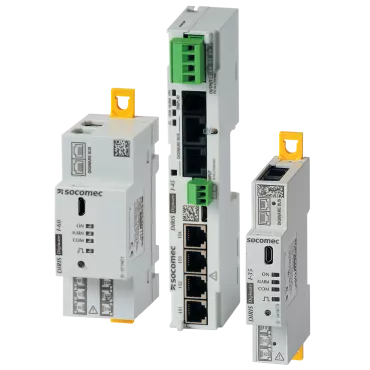
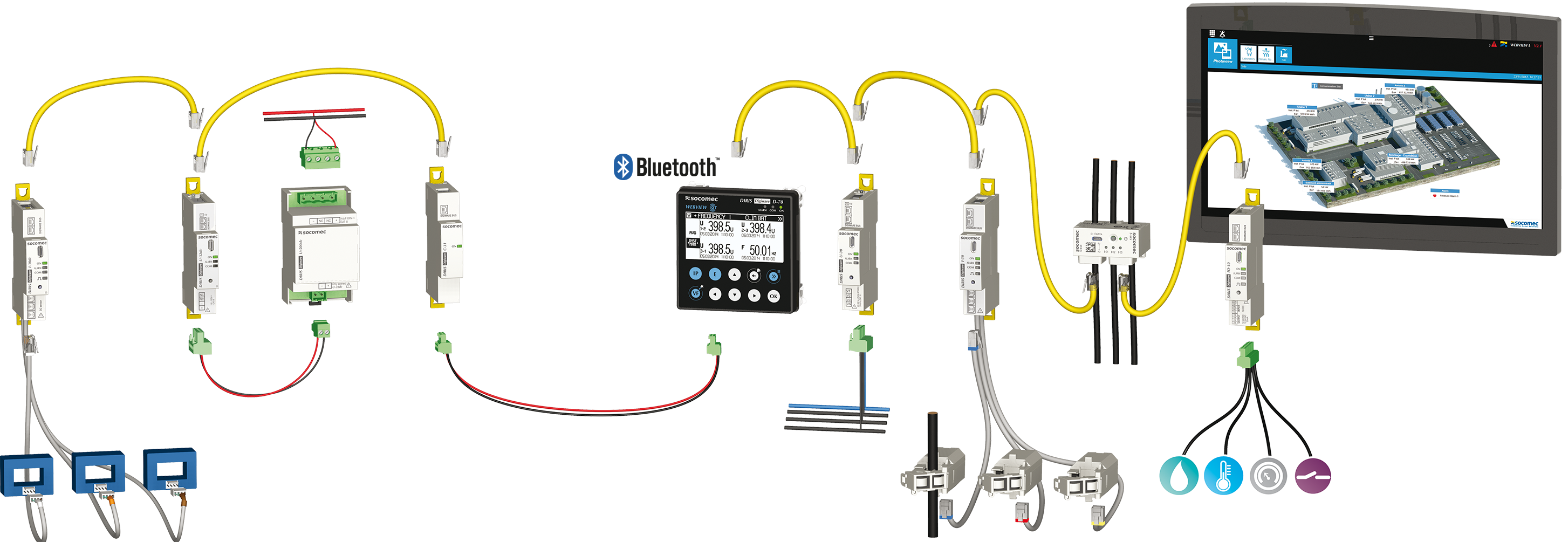
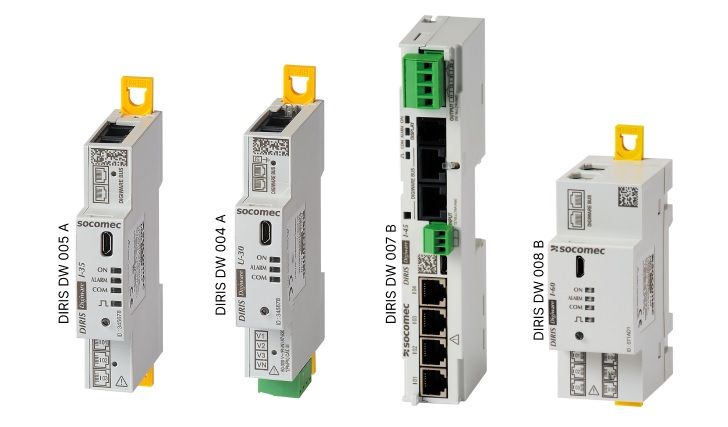
Diris Digiware is a fully digital, multi-circuit plug and play measurement concept, with a common display for multi-circuit systems. Compact and quick to install, it provides accurate and effective metering, measurement and monitoring of electrical power quality. Infinitely scalable, it is capable of monitoring thousands of connection points from the main incomer to the IT rack. A modular power distribution system is a key element in implementing a power monitoring solution within a data centre. This advanced – yet simple to use – system enables data centre managers to more effectively manage power usage, and rapidly respond to changing power requirements.
Socomec’s Diris Digiware system offers an accuracy of class 0.5 to IEC61557-12 from 2% to 120% of the current sensor primary rating.
“By retrofitting the Digiware B-30 within one of three data halls – each with two pump sets – we have been able to monitor and measure the power usage for that specific data hall, in turn delivering a far more advanced understanding of energy efficiency. Now, when making adjustments, we can confirm – conclusively – that they have been effective, enabling us to make more informed decisions in the longer term.”
Timothy Arnold,
Technology Director at Six Degrees
The advantages of the system
Rapid live retrofit – without downtime
Timothy Arnold, Technology Director at Six Degrees, identified Socomec’s Digiware range for a number of critical applications.
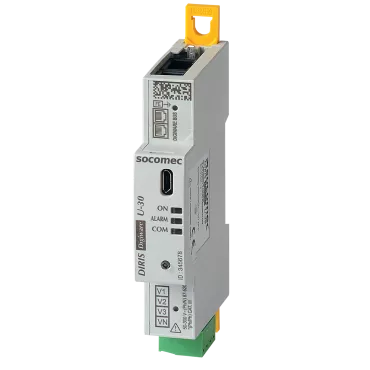
Modular Digiware solutions - including the I-30 and U-30 - have also been deployed by Six Degrees to monitor a larger number of circuits in one location.
Arnold comments: “Previously, with in-rack PDU monitoring, we experienced a number of failures as legacy equipment was operating at higher temperatures whilst not being designed specifically for this purpose. Rather than turn them off, we were able to retrofit Digiware live – without downtime – ensuring that the change was invisible from our customers’ perspective.
In this instance, the modularity of the Digiware solution was a significant benefit.
Rather than having to deploy it for all racks across all customers, and because Digiware is mounted in the 3 phase PDU rather than the rack, we have been able to scale-up over time, therefore reducing capital cost”.
“Furthermore, the installation was rapid; it actually took longer to unbox the equipment than it did to install it”.
Optimizing chiller performance – and energy consumption
Arnold explains: “We also increasingly need to better understand the specific power utilization within a facility. Although we have historically been able to determine the power utilization for an entire building, we have not previously been able to monitor the power utilization across unique data halls – and different pump sets – within that building. Optimizing chiller performance – and energy consumption – has not previously been possible”.
“By retrofitting the Digiware B-30 within one of three data halls – each with two pump sets – we have been able to monitor and measure the power usage for that specific data hall, in turn delivering a far more advanced understanding of energy efficiency. Now, when making adjustments, we can confirm – conclusively – that they have been effective, enabling us to make more informed decisions in the longer term. Furthermore, as well as determining the energy usage for a specific hall, we can even drill down to individual pump set level, identifying whether one is running harder than the other, for example”.
“As a standalone module installed directly into the pumpset panel, Digiware was easy to integrate. Rather than needing to have multiple controls and a larger system, the Digiware B-30 can be deployed in an isolated environment and into the end unit – rather than deploying full modules. The initial trial has been so successful that we are now rolling the solution out across the other two data halls”.
This granular level of monitoring is particularly beneficial for colocation facilities whose environments are continually evolving. Conversely, systems that are using lower levels of power can be consolidated resulting in improved energy efficiency resulting by association in lower operating costs for either the provider or end user.
“We are also testing Digiware in other scenarios – in determining UPS efficiencies, for example. I am currently using Digiware as a power logger – a really cost effective solution that has saved me a significant amount of cash”, said Arnold.
“Across all of these applications, we are now working with accurate and reliable data which means that we can make more informed decisions on how to improve our facilities, particularly in terms of energy efficiency and meeting the terms of the climate change agreement. We can deploy our capital expenditure more effectively as we better understand how energy is being used – and there is zero downtime for monitoring”.