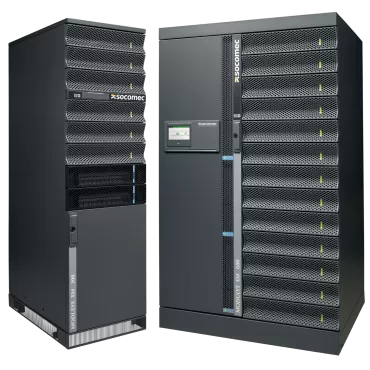
When the UPS reaches end of life
“I always dread the moment when a UPS reaches the end of its life,” shared our client’s Data Centre Manager. “It’s not just about the cost of replacement — it’s the risk of switching off the very system that keeps everything on.”
In the data centre world, end of life is less a technical milestone than an operational risk. Replacing a UPS means exposing critical loads to transition points and potential downtime. For operators whose mission is 24/7 continuity, that risk is the real threat.
That’s why electrical architectures have evolved towards modularity and maintainability, enabling hot-swap module replacement, progressive renewal and predictable lifecycle management - but at Socomec, that evolution is going even further.
Interestingly, hard-working architectures are also echoing a growing sustainability mindset: keeping reliable systems in service for longer, replacing only what’s necessary, and reducing waste.
In other words, designing for longevity first naturally results in a more sustainable infrastructure — a synergy born from engineering discipline, not marketing trends.
UPS lifecycle - Understand the natural ageing of the UPS
As soon as a new UPS is installed, a process of natural ageing and deterioration begins, defining the UPS lifecycle. Some of the UPS components, capacitors and fans have a defined life and are therefore considered to be “consumables”. These are replaced as part of optimise data centre maintenance programmes at defined intervals, thus increasing the UPS lifecycle to between 10 and 15 years.
Beyond this period, electronic components also start to age.
For the MODULYS XM, however, the management of ageing is not limited to the replacement of worn parts — it’s about maintaining technological relevance over decades.
That is why the system is engineered around an electronics-free cabinet architecture, allowing independent plug-in modules — power, control, or communication — to be replaced or upgraded safely, while the UPS remains fully operational.
Manage UPS end of life
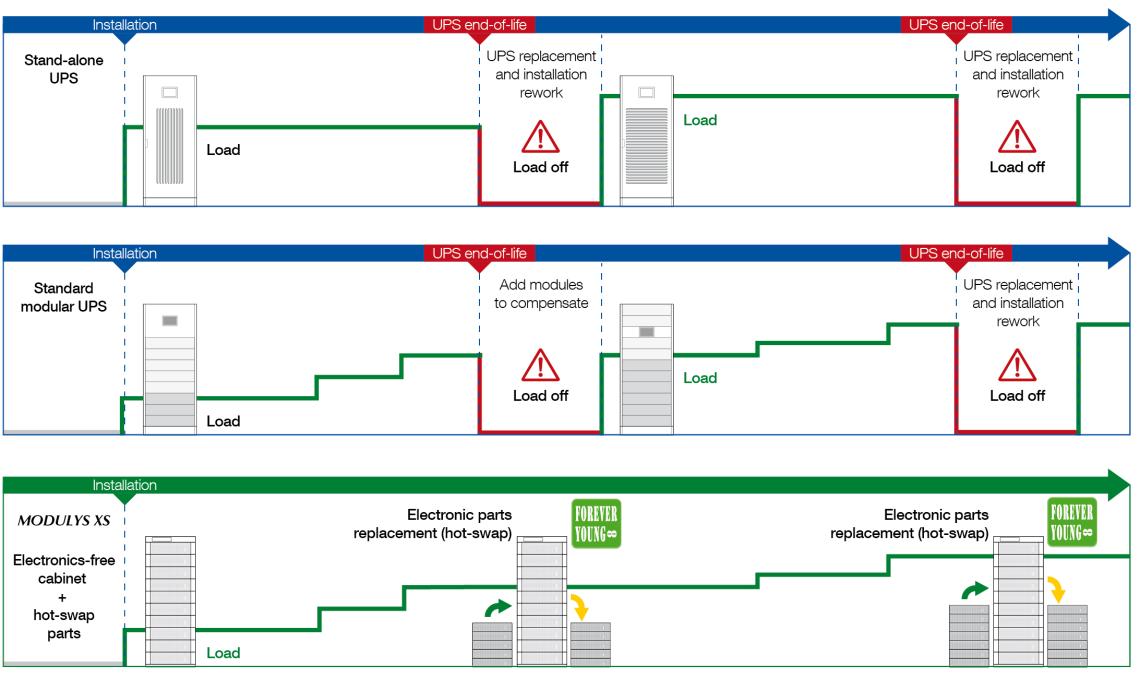
With a standalone UPS, the replacement is a binary event: once the system reaches its end of life, the entire unit must be shut down and swapped. This operation inevitably exposes the load to a period of vulnerability — a planned outage, but an outage nonetheless.
Standard modular UPS architectures improved this scenario by introducing power modules that share the load and can be replaced individually. At system end of life, however, the central structure — the frame, control logic and distribution elements — still requires full replacement. The process remains disruptive and involves requalification and electrical reconnection.
In comparison, ultra modular UPS take the concept further. It allows the hot-swapping of electronic parts and power modules without disconnecting the load, enabling the progressive renewal of components while the system stays online. In this approach, end of life is no longer a shutdown point but a controlled, continuous evolution phase that extends the useful life of the installation and minimises operational risk. To reinforce availability beyond lifecycle strategy, see how to minimise UPS failures in data centres. With MODULYS XM, this renewal concept evolves even further — transforming lifecycle extension into true system modernisation, where the UPS can integrate new generations of technology over time.
A true ultra modular UPS is engineered to match the lifetime of the application it protects. In other words, its design philosophy is rooted in durability, adaptability, and continuity.
It is not a system that simply resists ageing — it’s a system that evolves alongside your data centre infrastructure guide.
With MODULYS XM, Socomec guarantees a lifetime of more than 20 years, certified by third party (assuming that the UPS receives the proper maintenance). Its architecture allows the UPS to remain as reliable and relevant on day 7,000 as it was on day one.
Beyond physical ageing: avoiding technological obsolescence
End of life is not only a physical concept. It is also a technological milestone and an ultra modular UPS must therefore be built to simplify technological progress.
This means anticipating change and allowing modernisation without replacement.
With MODULYS XM, this challenge is addressed through several design choices:
- Electronics-free cabinet: the cabinet serves only as the mechanical and power frame — all electronic functions are housed in independent, plug-in modules.
- Full front access: components can be reached and serviced from the front, simplifying maintenance and replacement.
- Hot-swap capability: all modules — power, control, communication, HMI — can be replaced or added while the UPS is running, with no impact on the load.
- Selective replacement: only modules where impacted components need to be replaced (such as power electronics) are renewed over time, extending the system’s service life.
- Automatic firmware alignment: when a new module is inserted, the UPS automatically synchronises firmware versions and settings, ensuring seamless operation and immediate reintegration.
Together, these principles transform a traditional modular UPS into a living, serviceable system — one that adapts to the longevity of your application.
But can we go even further?
Forever Young — modernisation that keeps pace with your business
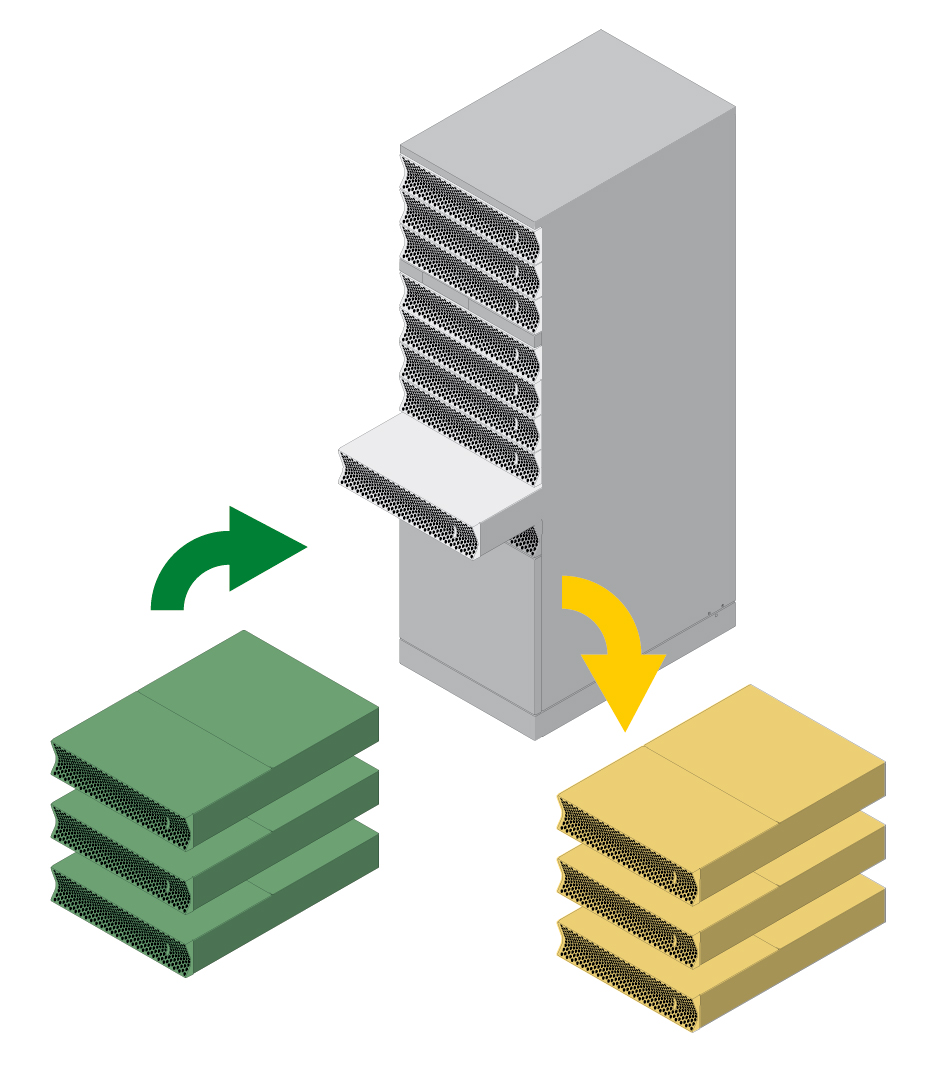 For Socomec, having already mastered the challenge of replacing electronic parts, the new hurdle is to take this approach even further. Rather than simply focusing on component replacement, Socomec aims to redefine what longevity means for critical infrastructure.
The Forever Young concept for MODULYS XM ensures that the UPS can be upgraded and modernised throughout its service life — keeping it aligned with evolving technologies, standards and user expectations.
With every module being independent and hot-swappable, the UPS can be enhanced at any stage — for example, by integrating a new, more user-friendly touchscreen interface or ultra high-efficiency power modules — all without changing the entire system or interrupting the load.
Benefits that last
- Preserve your initial investment — no need to replace the complete UPS, even after 20 years.
- Stay compatible with the future — upgrade only some parts and technology while keeping your existing infrastructure (cabling configuration, busbars, protections, footprint).
- Ensure continuous operation — all updates and modernisation steps can be carried out online, without downtime.
- Reduce waste and operational costs — replace only what is needed, when it is needed.
- Keep your system alive and relevant — always up to date, always ready for tomorrow’s challenges.
Socomec officially guarantees that MODULYS XM’s operational lifetime exceeds 20 years, ensured by the continued availability of compatible power modules and spare parts throughout its entire lifespan.
The UPS that evolves — not just endures
The MODULYS XM embodies a new generation of resilience and sustainability. It doesn’t just last longer — it stays modern, efficient and adaptable throughout its entire lifespan.
Forever reliable. Forever efficient. Forever Young.
Want to learn more?
Contact your sales representative for a product introduction.